
How to Ship Dangerous Goods Internationally Safely in 2026
Introduction
Shipping dangerous goods internationally is not like shipping ordinary cargo. One wrong classification, one missing label, or one inconsistent document can stop a container at the port gate, trigger a customs hold, or expose you to fines that wipe out the margin of an entire shipment. Every year, dangerous goods (DG) consignments from China are delayed at Qingdao, Shanghai, and Shenzhen for exactly these reasons — and in 2026 the stakes are higher, because IMDG Code Amendment 42-24 became mandatory on 1 January 2026, changing UN numbers, packaging instructions, and documentation expectations for batteries, vehicles, and other goods.
This guide walks through how to ship dangerous goods internationally in 2026, step by step: the nine hazard classes, the regulations that apply by transport mode, UN packaging and labeling, the documents that must match, the mistakes that get cargo rejected, and how to choose a forwarder who will not let your shipment become a lesson. Whether you are shipping chemicals, batteries, or flammable liquids, the same principle applies: compliance is a checklist, not a mystery.
1. What Are Dangerous Goods? Understanding the 9 Hazard Classes
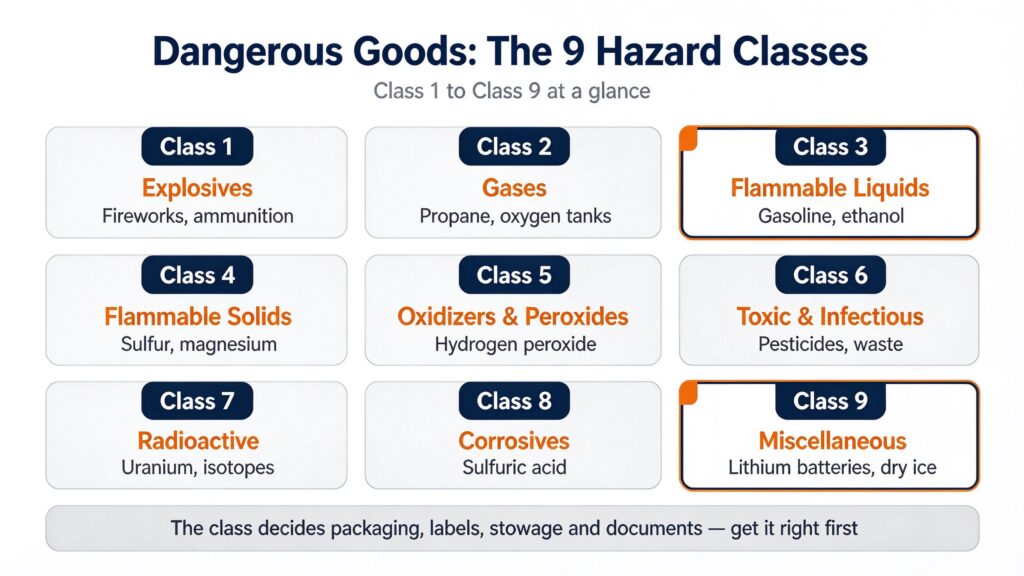
Dangerous goods are materials that pose a risk to health, safety, or the environment during transport. Under the UN system, they are divided into nine hazard classes, each with its own rules for packaging, labeling, stowage, and documentation:
| Class | Hazard Type | Examples | Shipping Risks |
|---|---|---|---|
| Class 1 | Explosives | Fireworks, ammunition | Detonation risk |
| Class 2 | Gases | Propane, oxygen tanks | Pressure leaks, flammability |
| Class 3 | Flammable Liquids | Gasoline, ethanol, paint | Fire hazard |
| Class 4 | Flammable Solids | Sulfur, magnesium | Spontaneous combustion |
| Class 5 | Oxidizers & Organic Peroxides | Hydrogen peroxide, fertilizers | Chemical reactions |
| Class 6 | Toxic & Infectious Substances | Pesticides, medical waste | Poisoning, contamination |
| Class 7 | Radioactive Materials | Uranium, medical isotopes | Radiation exposure |
| Class 8 | Corrosives | Sulfuric acid, batteries | Metal/body tissue damage |
| Class 9 | Miscellaneous Hazards | Lithium batteries, dry ice | Thermal/chemical risks |
Why the class matters before anything else:
- Proper classification is the foundation of every other step. The class, combined with the UN number and packing group, determines the packaging, the labels, the segregation rules, and the documents. Get the class wrong and everything downstream is wrong.
- Mislabeling — for example, shipping a Class 3 flammable liquid as general cargo — is one of the most common reasons Chinese export containers are rejected at gate-in, and in the worst case it causes incidents at sea.
- Each class has dedicated rules. Class 3 liquids require UN-certified drums and flash-point documentation; Class 7 radioactive materials require shielding and special stowage; Class 9 lithium batteries require UN38.3 testing and certified packaging. There is no “general cargo” shortcut.
A practical way to remember the classes at a glance is our hazard class overview infographic, which you can reuse in internal training as well as on your website.
2. How to Ship Dangerous Goods Internationally: Key Regulations by Mode
Dangerous goods are regulated by international rules that vary by transport mode. A shipment by sea follows the IMDG Code; by air it follows the IATA Dangerous Goods Regulations (DGR); by road and rail within Europe it follows ADR/RID. The rules overlap on classification and packaging but differ on limits, documentation, and prohibitions.
a) Air freight — IATA DGR
- UN-certified packaging and correct specification marks
- Class labels and UN numbers on every package
- Dangerous Goods Declaration (DGD) signed by a trained shipper
- Operator-specific restrictions — many airlines prohibit certain goods as cargo on passenger aircraft (for example, standalone lithium batteries under UN3480)
Air is the most restrictive mode. If your cargo can move by sea, it is usually cheaper, simpler, and subject to fewer prohibitions — which is why most volume DG from China ships by ocean.
b) Sea freight — IMDG Code
- Segregation rules that keep incompatible classes apart in the container and on the vessel
- Special stowage requirements — some goods must be on deck, under controlled temperature, or away from heat sources
- Container testing and securing standards — the container itself must be inspected, and cargo must be blocked and braced
- Amendment 42-24 changes since 1 January 2026 — new UN numbers for battery-powered vehicles (UN 3556/3557/3558), new packing instruction P912, and tighter documentation expectations
For the full list of what changed in the 42-24 amendment, see our IMDG Code 2026 update guide. The underlying regulatory framework is published by the International Maritime Organization, which maintains the IMDG Code and the wider maritime safety framework.
c) Road / rail — ADR/RID
- Driver training and vehicle safety checks — ADR requires certified vehicles and trained drivers for carriage by road
- Route restrictions — some hazardous cargo is limited to specific roads, tunnels, or times
- Documentation in the vehicle — the transport document must travel with the load
Most international DG shipments from China begin with road transport to the port, so even a sea-freight booking needs ADR-compliant trucking on the China side.
3. Dangerous Goods Packaging & Labeling Requirements
Once the class and UN number are fixed, the package must meet the UN performance standard for that packing group — and it must say so, visibly.
The packaging rules that matter most:
- UN-approved containers. Drums, jerricans, boxes, and IBCs must carry a UN specification mark (for example, a 4G fibreboard box or 1A1 steel drum certified for the relevant packing group), and the certificate must be within its validity period.
- Leak-proof and impact-resistant construction. Packaging is tested to survive drop, stacking, and pressure tests. A “strong carton” that has not been tested is not UN packaging.
- Correct inner packaging. Many goods need inner receptacles, cushioning, and segregation so that incompatible contents cannot react or shift in transit.
- Correct hazard labels. Every package shows the class label (the hazard diamond), the UN number and Proper Shipping Name, and any additional marks required by the entry (lithium battery mark, marine pollutant mark, limited quantity mark, and so on).
For a mode-by-mode breakdown of packaging rules, see our guide on packaging requirements for dangerous goods in ocean transport.
4. Documentation for International Dangerous Goods Shipping
The physical cargo is only half of compliance — the file is the other half, and carriers check the file before they check the box. For an international DG shipment from China, the required documents include:
| Document | What It Must Show | Issued By |
|---|---|---|
| Safety Data Sheet (SDS/MSDS) | Product identity, hazards, Section 14 transport data (UN number, PSN, class, packing group) | Manufacturer / lab |
| Dangerous Goods Declaration (DGD) | UN number, proper shipping name, class, quantity, packing group, emergency contact | Shipper / forwarder |
| UN packaging certificates | Performance certificate and China packaging use certificate | Testing lab / local inspection authority |
| Transport condition identification report | Classification confirmation for customs declaration | Qualified lab |
| Country-specific permits | Import/export licenses, phytosanitary or customs permits where required | Authorities |
The critical rule is consistency: the UN number and proper shipping name must be identical on the SDS, the DGD, the booking, and the package marks. A mismatch between the MSDS and the DGD is the most common reason cargo is rejected after arrival at the port. We explain which fields deserve special attention in our MSDS checklist for dangerous goods shipping.
5. The 5-Step Process: From Classification to Clearance
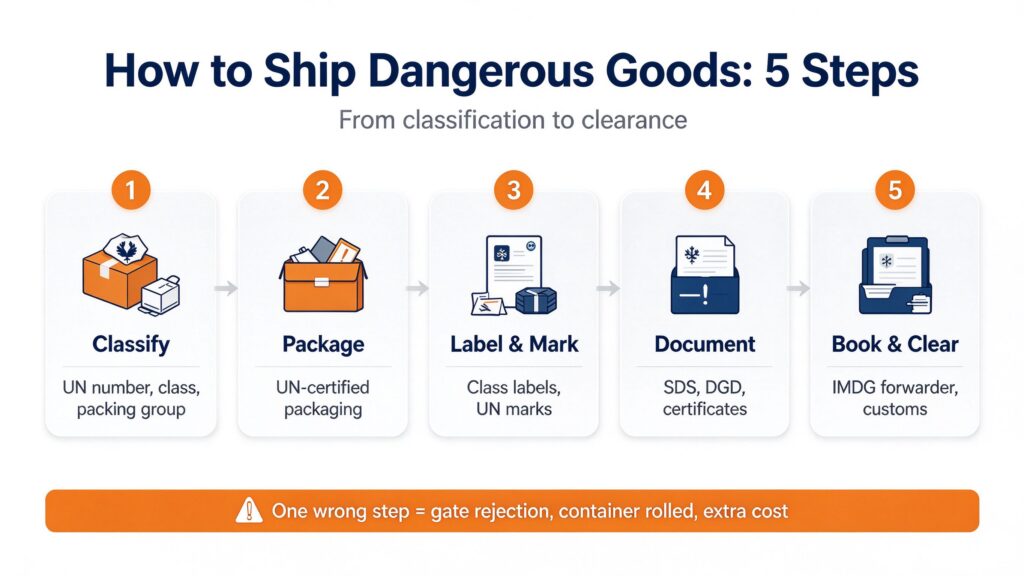
If you are shipping dangerous goods internationally for the first time, or reviewing an existing process, this is the sequence that works:
- Classify — determine the UN number, hazard class, and packing group from the SDS, using a qualified classification if you are unsure.
- Package — select UN-certified packaging matched to the packing group, with correct inner packaging and cushioning.
- Label and mark — apply class labels, UN numbers, and special marks to every package.
- Document — prepare the SDS, DGD, and supporting certificates so every field matches.
- Book and clear — submit the file to an IMDG-certified forwarder, confirm carrier acceptance and stowage, and handle the China-side customs declarations.
This sequence is exactly what our DG team at Eastern Cargo follows on every consignment from Qingdao and other Chinese ports — document review first, then booking, then a transparent quote.
6. Common Mistakes in Dangerous Goods Logistics
These are the mistakes we see most often — and every one is preventable before booking:
- Incorrect classification — the wrong UN number, or a product classified as general cargo to “save cost.” Detected at the gate and rejected, with the container rolled.
- Improper labeling — missing hazard diamonds, missing UN marks, or labels that do not survive the voyage.
- Insufficient packaging — non-UN cartons, expired certificates, or packaging not matched to the packing group.
- Missing documentation — no DGD, no SDS, or documents that do not match each other.
- Inconsistent data across documents — the same shipment declared under two different UN numbers in the SDS and the DGD.
- Outdated regulation knowledge — still using 2024 rules after Amendment 42-24 took effect in January 2026 (for example, booking a lithium-ion e-bike under UN 3171 instead of UN 3556).
Each of these converts a shippable consignment into a delayed, fined, or rejected one. If you are unsure about any of them, ship through an IMDG-certified DG freight forwarder who reviews the file before it reaches the carrier.
7. How to Choose a Reliable Dangerous Goods Shipping Provider
Battery and chemical cargo is where the difference between a general forwarder and a DG specialist shows up fastest. When selecting a forwarder for dangerous goods from China, check five things:
- Certification depth — the team should hold IATA/IMDG/ADR training certificates, not just a license on the wall.
- Experience with your cargo type — a forwarder who ships Class 3 liquids every week understands flash-point documentation; one who ships “sometimes” does not.
- Pre-booking document review — the forwarder should review your SDS, DGD, and packaging certificates before requesting space and tell you exactly what to correct. A forwarder who asks no questions about your DG file is a risk, not a convenience.
- Direct carrier relationships for DG space — DG bookings are not the same as general bookings. A forwarder with allocated DG space at your port pair gets your container on board when space is tight.
- Global network for smooth customs clearance — including the China-side packaging use certificate and transport condition identification report, which no carrier booking can fix if mishandled.
For a closer look at the specific rules that apply to one of the fastest-growing DG categories, see our guide on lithium battery shipping requirements.
Frequently Asked Questions
Q1: What is the difference between dangerous goods and hazardous materials? There is no practical difference in international shipping. “Dangerous goods” is the term used by the IMDG Code and IATA DGR; “hazardous materials (HAZMAT)” is the common US term. Both refer to the same nine UN hazard classes.
Q2: Do I need UN-certified packaging for every dangerous goods shipment? Yes. Packages must meet the UN performance standard for the relevant packing group and carry the UN specification mark. The one important nuance is that a few entries (for example, the new vehicle entries UN 3556/3557/3558) use packing instructions like P912 that require rigid securing without UN type-testing — but the general rule is UN-certified packaging.
Q3: What documents do I need to ship dangerous goods from China? As a minimum: the Safety Data Sheet (SDS/MSDS), the Dangerous Goods Declaration (DGD), UN packaging certificates (performance + China use certificate), and a transport condition identification report for customs. Your forwarder should confirm the full list for your specific goods and destination.
Q4: How long does a dangerous goods sea shipment from China take? Typical transit to Europe is 25–40 days and to the US West Coast 15–25 days, plus 3–7 days for DG booking and documentation before sailing. DG space is more limited than general space, so book early.
Q5: Can I ship lithium batteries internationally? Yes — by sea and by air under specific conditions. Batteries are Class 9, requiring UN38.3 testing, certified packaging, and a DGD. Since 1 January 2026, battery-powered vehicles must be declared under the new entries UN 3556/3557/3558 rather than the old UN 3171.
Q6: What happens if my dangerous goods are rejected at the port? The container is either re-consolidated for correction (at your cost), re-exported, or in serious cases subject to penalties. Rejection typically costs weeks and hundreds to thousands of dollars — which is why a pre-booking document review by a DG forwarder pays for itself.
Conclusion
Mastering dangerous goods shipping is about following a checklist, not taking risks. Classify correctly, package to the UN standard, label properly, keep every document consistent, and choose a forwarder who reviews the file before the carrier does. Do that, and your dangerous goods will ship internationally without delays, fines, or drama.