
17 Essential Elements Checklist for MSDS (Material Safety Data Sheet) | 2026 Latest Standards
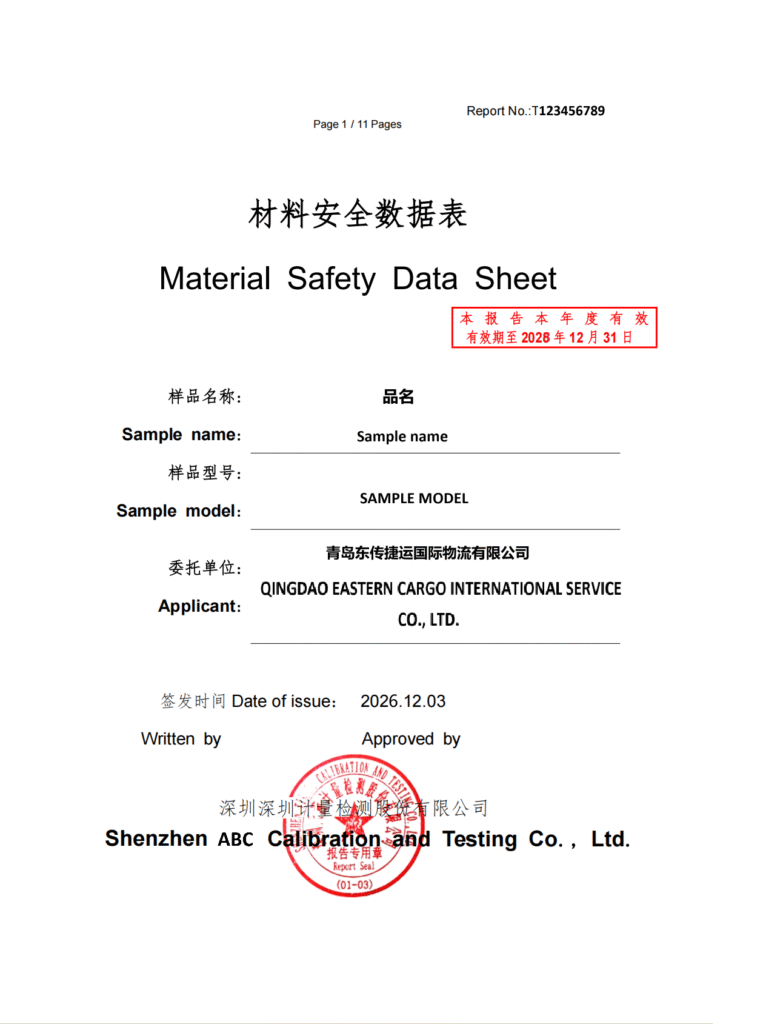 MSDS (Material Safety Data Sheet) serves as the core safety document for chemical transportation, storage, and usage. According to GHS (Globally Harmonized System of Classification and Labelling of Chemicals) and OSHA Hazard Communication Standard (29 CFR 1910.1200), a compliant MSDS must contain 17 standard elements. This article provides a complete verification checklist and details the key requirements for each section.
Why Your MSDS Decides Whether Your Cargo Ever Boards the Vessel
One wrong line in a Material Safety Data Sheet (MSDS) can stop a container at the port gate. It can trigger a customs hold, a carrier refusal, an inspection delay of two to four weeks, or a compliance fine that wipes out the margin of an entire shipment. For dangerous goods (DG) moving by sea from China, the MSDS is not a formality — it is the single document that determines whether your goods are classified correctly, packed legally, declared accurately, and accepted by the vessel.
The International Maritime Dangerous Goods (IMDG) Code, published by the International Maritime Organization, requires every DG consignment to be supported by accurate documentation before a carrier will issue space. The MSDS sits inside the wider IMO maritime safety framework, which means the document is read not only against the IMDG Code but also against the international conventions that govern how hazardous goods may be presented, carried, and responded to at sea. In practice, the MSDS is the foundation document that classification, the Dangerous Goods Declaration (DGD), packaging selection, and booking all depend on. Get it right and a compliant shipment clears in days. Get it wrong and you discover the cost of correction only after the vessel has sailed.
This guide breaks down the 17 essential elements we check on every MSDS at Eastern Cargo, explains why Section 14 deserves special attention, lists the mistakes that get cargo rejected, and gives you a review checklist you can use before you request a quote.
What Is an MSDS/SDS and Why It Matters for Ocean Freight
MSDS (Material Safety Data Sheet) and SDS (Safety Data Sheet) are used interchangeably in the logistics industry. The term SDS became the official name under the Globally Harmonized System of Classification and Labelling of Chemicals (GHS), but Chinese exporters, customs brokers, and freight forwarders still commonly say MSDS. The document itself is the same: a structured, 16-section record of a product’s chemical properties, hazards, handling requirements, and — most importantly for shipping — its transport classification.
For ocean freight, the MSDS matters in four ways:
- Classification. It provides the flash point, boiling point, and hazard properties that determine whether a product falls under Class 3 (flammable liquids), Class 8 (corrosives), or a more dangerous class — and which UN number and packing group apply.
- Acceptance. Carriers and the port’s DG review team use the MSDS to decide whether the goods can be accepted, and on which terms (segregation, temperature control, stowage category).
- Emergency response. The MSDS carries the 24-hour emergency contact and the first-aid, fire-fighting, and spill procedures that the crew relies on in an incident.
- Compliance evidence. Customs and the shipping line cross-check the MSDS against the DGD, the packaging certificates, and the booking. Inconsistencies are the most common reason cargo is rejected at gate.
A compliant MSDS therefore is not “a document that exists.” It is a document where every one of the 17 elements below is present, accurate, and consistent with the rest of the shipment file.
The 17 Essential Elements of a Compliant MSDS
The GHS structure defines 16 numbered sections. In freight-forwarding practice, we add a 17th element that is not on the form itself but determines whether the form works: cross-document consistency. Here is the full checklist, with the elements most likely to get your cargo rejected flagged.
Sections 1–8: Identification, Hazards, and Handling
| # | MSDS Section | What Must Be Present for Ocean Freight | Why It Matters |
|---|---|---|---|
| 1 | Identification | Product name (trade name), manufacturer, 24-hour emergency contact | IMDG requires a genuinely reachable emergency number; an unreachable one is a rejection trigger |
| 2 | Hazard Identification | GHS pictograms, signal word, hazard statements (H-codes), precautionary statements (P-codes) | Drives classification and labeling on the package |
| 3 | Composition/Information on Ingredients | CAS numbers, concentration ranges | CAS numbers must match the DGD and the Chinese export declaration |
| 4 | First-Aid Measures | Symptoms and treatment by route of exposure | Required by IMO for emergency response on board |
| 5 | Fire-Fighting Measures | Suitable extinguishing media, specific hazards | Class 3 liquids and organic peroxides need special fire guidance |
| 6 | Accidental Release Measures | Containment and clean-up procedures, PPE | Checked by port DG inspectors during incident drills |
| 7 | Handling and Storage | Temperature limits, ventilation, segregation requirements | Some DG (e.g., UN3105 organic peroxides) require temperature control at sea |
| 8 | Exposure Controls/Personal Protection | Occupational exposure limits (OEL), PPE | Rarely decisive for shipping, but missing data signals a low-quality document |
Sections 9–16: Properties, Transport Data, and Regulatory Information
| # | MSDS Section | What Must Be Present for Ocean Freight | Why It Matters |
|---|---|---|---|
| 9 | Physical and Chemical Properties | Flash point, boiling point, vapor pressure, density, solubility | Flash point is the deciding input for Class 3 assignment — the most common classification dispute in China export cargo |
| 10 | Stability and Reactivity | Conditions to avoid, incompatible materials | Determines segregation and whether the substance is stabilized for transport |
| 11 | Toxicological Information | Acute toxicity data (LD50 where available) | Feeds into the packing group for toxic substances (Class 6.1) |
| 12 | Ecological Information | Aquatic toxicity, marine pollutant status | Marine pollutant (H-codes H400/H410/H411) changes labeling and segregation rules |
| 13 | Disposal Considerations | Waste disposal guidance | Required by IMO’s MARPOL context for residue handling |
| 14 | Transport Information | UN number, Proper Shipping Name (PSN), hazard class, packing group, marine pollutant, special provisions | The most critical section for ocean freight — see the detailed breakdown below |
| 15 | Regulatory Information | GHS/CLP/IMDG references | Confirms the document reflects the current regulatory edition |
| 16 | Other Information | Date of issue, revision history, sources | An MSDS older than the current IMDG edition is a red flag for carriers |
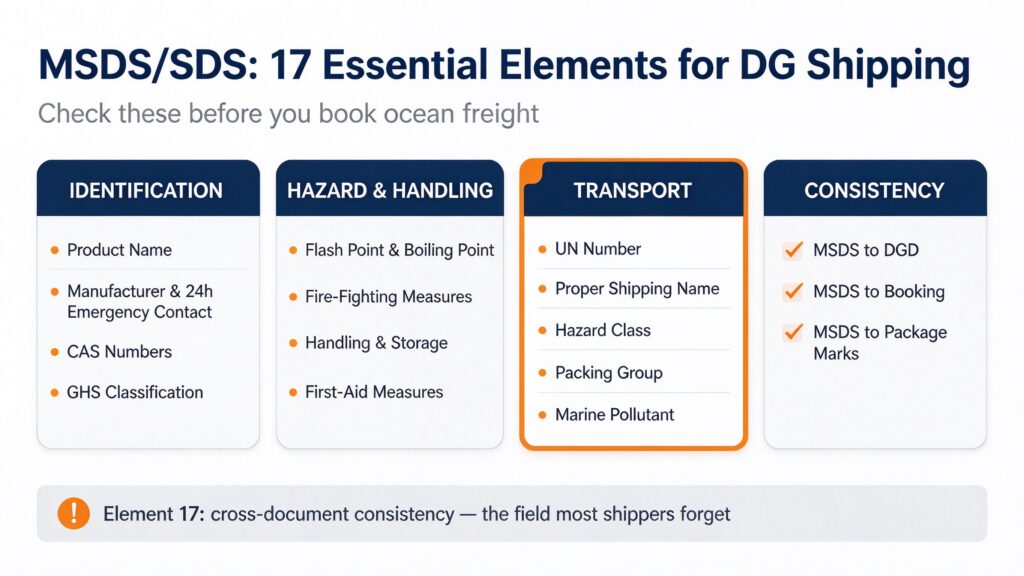
Element 17: Cross-Document Consistency (The Element Most Shippers Forget)
An MSDS can be perfect on its own and still sink a shipment, because it is never reviewed in isolation. The 17th element we check is consistency across the file:
- The UN number on the MSDS (Section 14) must match the UN number on the DGD, the booking, and the package marks.
- The PSN must match exactly — carriers reject paraphrased or translated names.
- The hazard class and packing group must agree with the classification report issued by the testing laboratory.
- The MSDS must be issued by the actual manufacturer, not a trading company, and the issuing entity must be reachable.
- For export from China, the MSDS must align with the GB/T 16483 format expectations and the Transportation Condition Identification Report.
At Eastern Cargo, the pre-shipment MSDS review is exactly this: a full cross-check of the 16 sections plus consistency against every other document in the file, before anything is submitted to the carrier.
Section 14: The Section That Decides Everything
Section 14 (Transport Information) is where the shipment actually lives. For ocean freight under the IMDG Code, a correct Section 14 must contain, at minimum:
- UN number — the four-digit identifier, e.g., UN1263 (Paints), UN1170 (Ethanol), UN3480 (Lithium-ion batteries).
- Proper Shipping Name (PSN) — the exact name from the IMDG Dangerous Goods List. It cannot be paraphrased.
- Transport hazard class(es) — Class 1–9, with subsidiary risks if any.
- Packing group — I, II, or III, which drives the packaging standard required.
- Marine pollutant — Yes/No, per the H400-series ecological codes.
- Special provisions — e.g., SP188 for small lithium batteries, which exempts certain quantities from full DG requirements.
- Transport in bulk / limited quantities / excepted quantities — if applicable.
Example of a compliant Section 14 for a common China export:
UN1263, PAINT (including paint in cans, spray paint), 3, III, Marine Pollutant: No
Every one of these fields must be consistent with the physical goods, the package marks, and the declaration. When our team reviews an MSDS for a client shipping paints from Qingdao, this is the paragraph we read three times — because carriers like Maersk, MSC, and COSCO reject bookings when Section 14 is ambiguous, even if every other section is complete.
6 Common MSDS Mistakes That Get Cargo Rejected
- Unreachable emergency contact. A mobile number that does not answer, or a company that no longer exists, is an automatic carrier rejection under IMDG Section 5.4.1.
- Wrong flash point or missing it entirely. Without a flash point, Class 3 classification is unverifiable, and the port DG reviewer will not accept the goods.
- CAS number mismatch. The CAS number on the MSDS differs from the one on the Chinese customs declaration or the classification report, triggering an inspection hold.
- Section 14 missing the packing group. A document with a UN number but no packing group cannot determine the required packaging standard.
- Marine pollutant not declared. Products with H400/H410/H411 codes shipped without the marine pollutant declaration face segregation violations.
- Trader-issued MSDS. The MSDS is issued by a trading company rather than the manufacturer. Chinese customs and the carrier both treat this as a due-diligence failure.
The pattern behind all six: the document exists, but it has not been checked against the shipment it describes. That is precisely what a professional MSDS review service exists to prevent.
Quick MSDS Review Checklist (Use Before You Book)
| Check | Pass | Fail |
|---|---|---|
| 16 GHS sections present and complete? | ☐ | ☐ |
| Section 14: UN number, PSN, class, packing group, marine pollutant all filled? | ☐ | ☐ |
| Flash point and boiling point filled in Section 9? | ☐ | ☐ |
| CAS numbers match the customs declaration and classification report? | ☐ | ☐ |
| 24-hour emergency contact reachable? | ☐ | ☐ |
| MSDS issued by the actual manufacturer? | ☐ | ☐ |
| UN number matches DGD, booking, and package marks? | ☐ | ☐ |
| MSDS reflects the current IMDG edition (2026: Amendment 42-24)? | ☐ | ☐ |
| GB/T 16483 format for China export respected? | ☐ | ☐ |
| PSN matches the IMDG Dangerous Goods List exactly? | ☐ | ☐ |
If any box is unchecked, do not book space yet. Correct the document first — correction is a two-day task; a port hold is a two-week one.
How Eastern Cargo’s MSDS Review Works
Every quote we provide for dangerous goods starts with a free pre-check of the MSDS and packing documents. An IMDG-certified specialist reviews:
- Classification validity — is the class, UN number, and packing group right, and does the IMDG regulation interpretation match the product?
- Packaging fit — does the packaging requirement match the packing group and the UN specification marks on the package?
- Documentation consistency — MSDS vs DGD vs booking vs package marks.
- Carrier acceptance — whether the specific shipping line will accept the commodity as declared.
If a document needs correction, we tell you exactly what to change before you go to the port — so the 15-minute quote protects you from a two-week delay.
Frequently Asked Questions
Q1: Is an MSDS the same as an SDS? Yes, for transport purposes the terms are interchangeable. SDS is the formal GHS term; MSDS remains common in China export documentation and in the freight industry.
Q2: Does every dangerous goods shipment need an MSDS? Yes. Any cargo classified as dangerous goods under the IMDG Code must be accompanied by a compliant MSDS that the carrier, the port DG department, and customs can rely on.
Q3: What happens if my MSDS is rejected at the port? The container cannot be loaded. You will either correct the document and resubmit for the next vessel (costing space and time) or face an inspection and possible fines for non-compliant declaration.
Q4: Can my supplier’s trading company issue the MSDS? It should not. The document must come from the actual manufacturer, and the emergency contact must be genuinely reachable. Trader-issued MSDSs are a leading cause of rejection in China exports.
Q5: How fast can you review my MSDS? Our standard review is same-day. Send the MSDS, the classification report (if available), and the destination port — we return a checklist with any required corrections, usually within a few business hours.
Q6: Does Eastern Cargo charge for MSDS review? The pre-shipment review is free as part of the quote process. Corrections guidance and full compliance support are included when you ship with us.
Tip for site owner: enable FAQPage structured data for this section in Yoast to qualify for rich results (see delivery notes).
Ready to Ship Dangerous Goods Without the Headaches?
A compliant MSDS is the cheapest insurance your shipment can buy. Send us your MSDS and packing documents today, and get a compliance review plus a transparent HAZMAT quote — usually within 24 hours.